Dietary Fiber for Athletes: How Much You Need, What the Science Says, and When to Supplement
Nutrition
Dietary Fiber for Athletes: How Much You Need, What the Science Says, and When to Supplement
Fiber is the most boring nutrient until you realize almost nobody gets enough — including athletes on high-protein, low-vegetable diets. It is not a sexy pre-session powder. It will not sell tubs on Instagram. But the epidemiology is enormous: higher fiber intake consistently predicts lower all-cause mortality, cardiovascular disease, type 2 diabetes, and colorectal cancer across meta-analyses commissioned for World Health Organization guidance (Reynolds et al., Lancet, 2019).
This is a practical guide: what fiber does, what the best papers actually found, how much to eat, when psyllium earns its place, and how to increase intake without gas and bloating killing your adherence.
What Dietary Fiber Actually Is
Fiber is the part of plant food your body does not fully digest — but your gut bacteria do.
Two buckets matter:
- Insoluble fiber — adds bulk, speeds transit (wheat bran, vegetable skins)
- Soluble / viscous fiber — forms a gel, binds bile acids, slows glucose absorption (oats, legumes, psyllium, apples)
- Fermentable fiber — feeds microbiota → short-chain fatty acids like butyrate (beans, onions, underripe bananas)
You do not need to micromanage types. Eat a mix of vegetables, legumes, oats, and fruit. Supplement only where diet is thin.
What the Research Shows
The evidence stack is unusually deep for a "basic" nutrient:
- *Reynolds et al., The Lancet (2019) — commissioned for WHO carbohydrate guidance; pooled 185 cohort studies and 58 RCTs (~135 million person-years). Highest vs lowest fiber consumers: 15–30% lower all-cause and cardiovascular mortality; clinical trials showed lower body weight, systolic blood pressure, and total cholesterol. Sweet spot: 25–29 g/day* (Mann, Reynolds, Cummings).
- *Threapleton et al., BMJ (2013) — 22 cohort studies: each 7 g/day more fiber ≈ 9% lower* cardiovascular disease risk.
- *Aune et al., BMJ Open (2018)* — dose-response meta-analysis linking higher fiber to lower all-cause, cardiovascular, and cancer mortality across prospective cohorts.
- *Anderson et al., Nutrition Reviews (2009)* — authoritative review of viscous soluble fibers lowering LDL and improving glycemic control.
- *Jovanovski et al., American Journal of Clinical Nutrition (2018) — RCT meta-analysis: psyllium* significantly lowers LDL cholesterol.
- *Ho et al., British Journal of Nutrition (2016)* — oat β-glucan ≥3 g/day reduces LDL in RCT meta-analysis.
- *Sonnenburg & Sonnenburg, Cell Metabolism (2014)* — low fermentable fiber depletes microbiota-accessible carbohydrates and erodes gut defences.
Bottom line: fiber is one of the strongest diet-mortality links in the medical literature — not a wellness fad. Most athletes still miss the target.
How Much Fiber Per Day
| Population | Target |
|---|---|
| General adults (WHO / Lancet evidence) | 25–30 g/day minimum |
| Hard trainers on low-veg diets | Often <15 g — fix this before optimizing supplements |
| Gradual ramp | Add 3–5 g/week until target — not 0 → 35 g overnight |
More than ~30 g may confer additional benefit in dose-response curves (Reynolds et al., 2019), but adherence beats hero doses.
Food First — Best Sources
| Source | Why it counts |
|---|---|
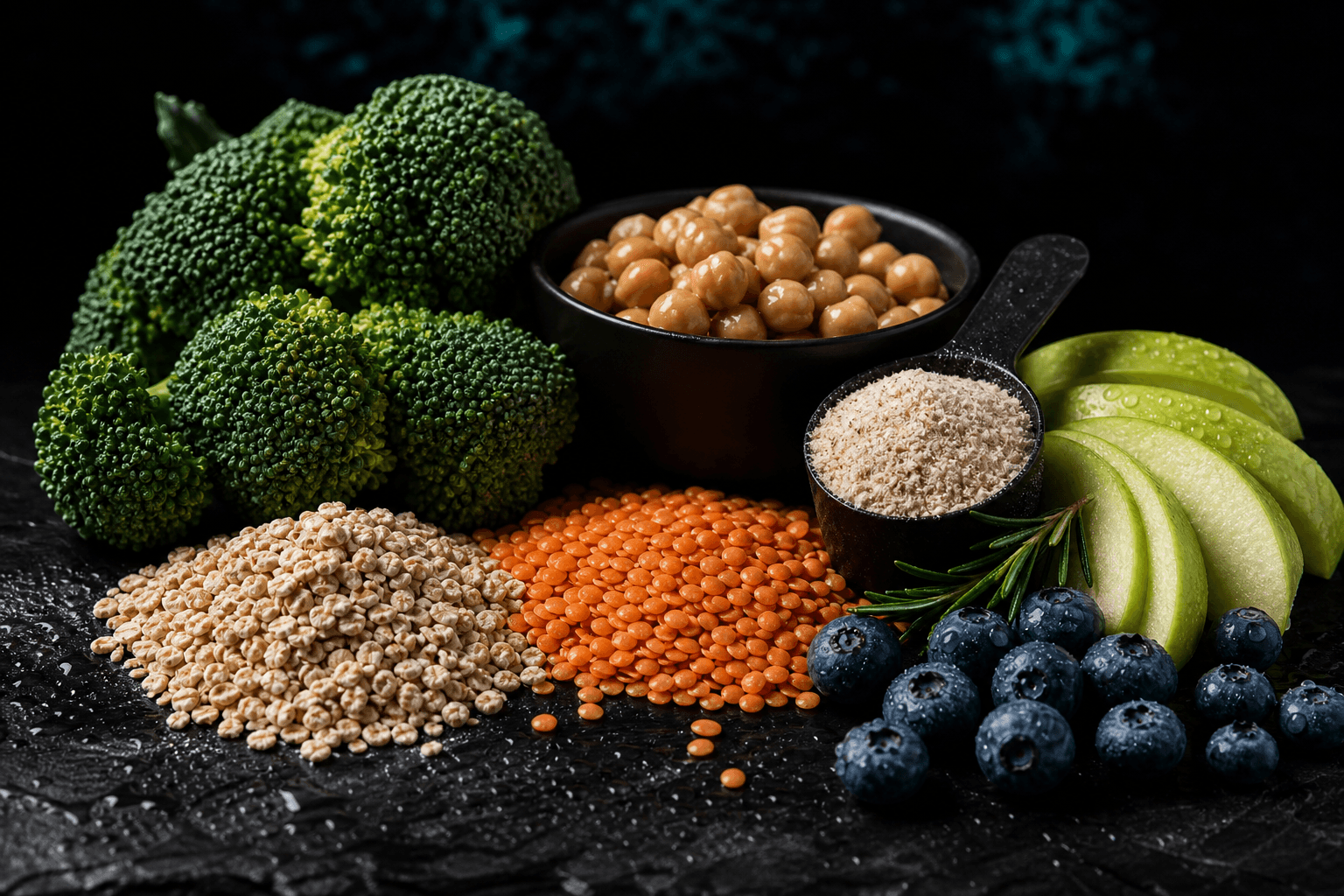
| Legumes (chickpeas, lentils, black beans) | High fermentable + soluble fiber |
| Oats / barley | β-glucan — LDL data in RCTs |
| Berries, apples, cruciferous veg | Mix of soluble + insoluble |
| Whole grains | Paired with Reynolds Lancet whole-grain findings |
Pair with quality protein and whole foods and nutrient-dense animal foods — fiber is the plant floor under a high-protein training diet.
Fibre is one of the few things in this category that is hard to fake — which is not true of most of what sits beside it on the shelf. Five checks that expose a substituted food, each doable standing in a shop.
Sample ~32 g food-only day:
| Meal | Sources | ~Fiber |
|---|---|---|
| Breakfast | ½ cup oats + 1 cup berries | ~10 g |
| Lunch | Large salad + 1 cup chickpeas | ~12 g |
| Dinner | Broccoli + sweet potato + protein | ~8 g |
| Snack | Apple + almonds | ~5 g |
When Psyllium Supplementation Makes Sense
Psyllium husk (Plantago ovata) is the best-evidence fiber supplement — viscous soluble fiber with RCT meta-analysis support for LDL cholesterol (Jovanovski et al., 2018).
Use it when:
- Diet is protein-heavy and vegetable-light
- LDL or fasting glucose are concerns (with your clinician)
- Travel or schedule kills vegetable intake temporarily
Protocol:
- Start: 3–5 g/day with a full glass of water
- Ramp: toward 10–15 g/day divided with meals over 2–3 weeks if tolerated
- Separate medications by 2+ hours — fiber binds drugs; ask your pharmacist
- Hydrate — dry psyllium without water worsens constipation
Food-first still wins for micronutrients and fermentable diversity. Psyllium is a tool, not a vegetable replacement.
Common Mistakes
Jumping dose too fast. Gas, bloating, abandonment. Ramp 3–5 g/week.
Fiber gummies only. Adherence-friendly, but often sugar alcohols. Whole food + psyllium if needed.
"Fiber fixes a trash diet." It reduces risk; it does not erase ultra-processed overload.
Ignoring iron timing. Phytate-rich bran can bind minerals — separate from iron supplements if deficient.
Fight-week fiber spikes. Weight-class athletes: build fiber in off-season, not days before weigh-in.
Who Should Be Careful
Talk to your clinician before aggressive fiber increases if you have IBD flare, gastroparesis, bowel obstruction history, or active iron deficiency with supplementation.
How It Fits Your Training
Fiber will not replace aerobic base work or creatine. It keeps the gut and metabolic floor stable under high protein load — the same foundation layer as omega-3s and magnesium.
Fiber sits inside The Fuel — ancestral fueling chosen for what it does to the cell, not for a column in a tracker. It supports the food-quality side without turning into a diet cult.
For hydration and between-session basics when volume is high: hydration & between-session support.
The Bottom Line
Fiber is unglamorous and under-dosed by almost everyone — including athletes. The best citations in the field (Lancet, BMJ, WHO-linked reviews by Jim Mann, Andrew Reynolds, John Cummings) point the same direction: 25–30 g/day, mixed sources, ramp slowly. Psyllium has real RCT backing when food falls short.
Eat plants. Ramp gradually. Fix the foundation before you optimize the stack.
Next: the five most commonly substituted foods in this diet, and the one check that exposes each — the five counterfeits.
References
- [1]Kreider RB, Kalman DS, Antonio J, et al. “International Society of Sports Nutrition position stand: safety and efficacy of creatine supplementation in exercise, sport, and medicine.” Journal of the International Society of Sports Nutrition, 2017
- [2]Branch JD. “Effect of creatine supplementation on body composition and performance: a meta-analysis.” International Journal of Sport Nutrition and Exercise Metabolism, 2003
- [3]Pérez-Guisado J, Jakeman PM. “Citrulline malate enhances athletic anaerobic performance and relieves muscle soreness.” Journal of Strength and Conditioning Research, 2010
- [4]Gough LA, Sparks SA, McNaughton LR, et al. “A critical review of citrulline malate supplementation and exercise performance.” European Journal of Applied Physiology, 2021
- [5]Jones AM. “Dietary nitrate supplementation and exercise performance.” Sports Medicine, 2014
- [6]Lansley KE, Winyard PG, Bailey SJ, et al. “Acute dietary nitrate supplementation improves cycling time trial performance.” Medicine & Science in Sports & Exercise, 2011
- [7]Domínguez R, Cuenca E, Maté-Muñoz JL, et al. “Effects of beetroot juice supplementation on cardiorespiratory endurance in athletes: a systematic review.” Nutrients, 2017
- [8]Hurrell R, Egli I. “Iron bioavailability and dietary reference values.” American Journal of Clinical Nutrition, 2010
Dark Kinetics
The five scrolls Musashi sealed at Reigandō in 1645, restored as a training doctrine and welded to cellular measurement.
Denshō
Earth, Water, Fire, Wind, Void — the doctrine this record sits inside. No consultation, no call to schedule.
OPEN THE DENSHŌ