五贋 · GOGAN
The Five Counterfeits.
Most matcha sold as ceremonial is culinary grade at a ceremonial price. Most wagyu is not Japanese. Gyokuro is the most routinely mislabelled tea in the West, because the difference is invisible through a sealed packet.
Five substitutions, and the single check that exposes each. No equipment, no second opinion, nothing you cannot do standing in a shop.
- 01
Matcha
Ceremonial grade
Sold as
Culinary-grade powder from later harvests, sometimes colour-corrected, sold at a ceremonial price. The phrase is unregulated — anybody may print it.The check
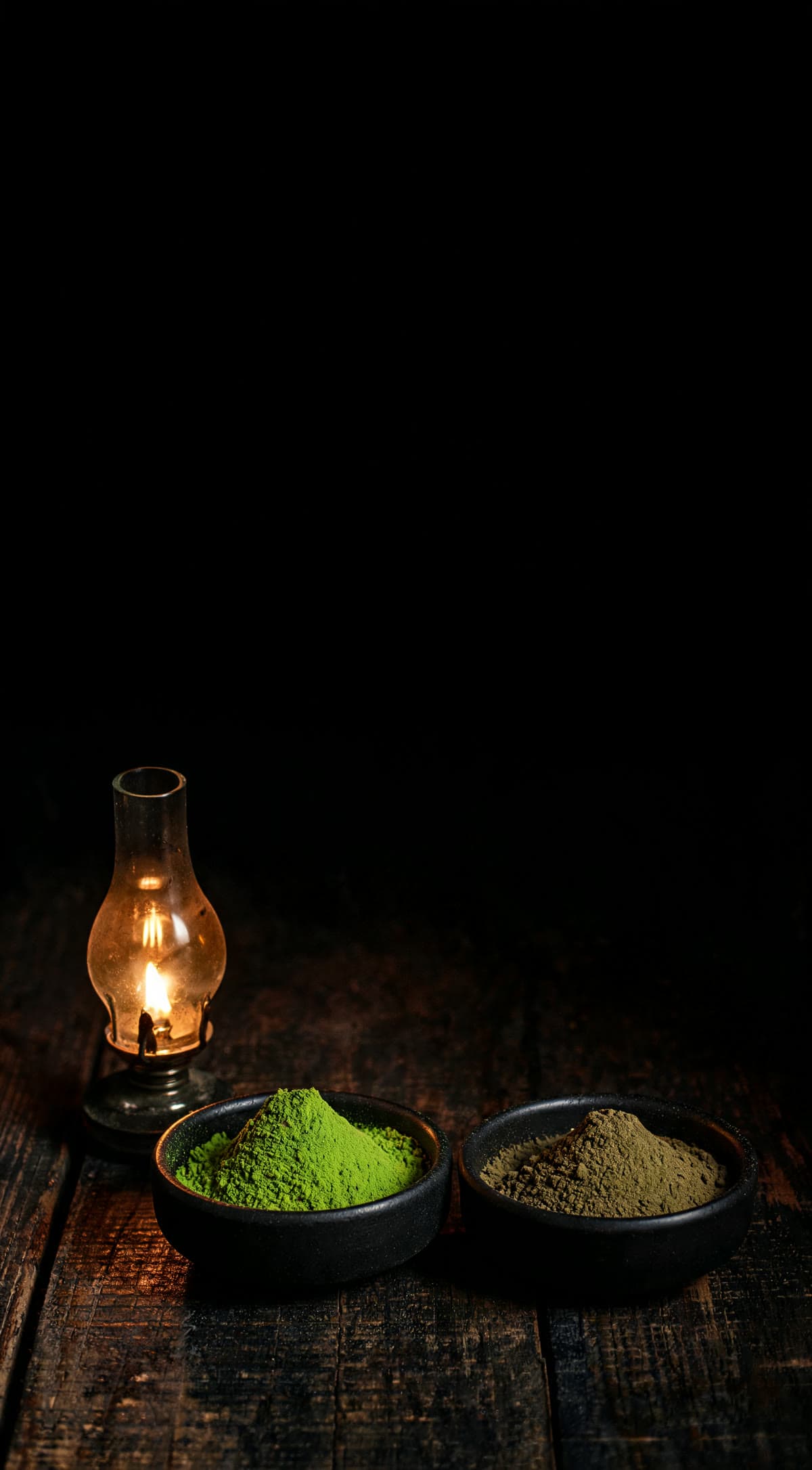
Look at the colour in daylight, then at the price per gram. Vivid jade is first harvest. Olive, khaki or yellow-green is a later one. Under roughly £1 a gram, it is not what the label says.
Shading before harvest is what drives the chlorophyll and the colour, and it costs the grower a crop's worth of yield. The colour cannot be faked cheaply and the price cannot be faked at all.
- 02
Wagyu
A5 Japanese
Sold as
Crossbred cattle raised outside Japan — often Australian or American — sold as wagyu, which describes a breed and not an origin.The check
Ask for the ten-digit individual identification number and the JMGA grade certificate. Real A5 Japanese beef carries both, traceable to the animal.
Japan runs a national traceability register; every animal has a number and every carcass a graded certificate. A seller who has the beef has the paperwork. A seller who has neither is telling you something.
- 03
Gyokuro
Shaded tea
Sold as
Sencha relabelled. It is the single most routinely mislabelled tea sold in the West, because the difference is invisible in a sealed packet.The check
Brew it at 50–60°C for two minutes. Gyokuro is thick, sweet and almost broth-like. Sencha brewed that cool is thin and tastes of very little.
Three weeks of shading raises L-theanine and suppresses the catechins that make tea astringent. That is what produces the sweetness, and unshaded leaf cannot produce it at any temperature.
- 04
Katsuobushi
Dried bonito
Sold as
Shavings bulked with additives, or arabushi sold at the price of karebushi — the same fish at an earlier and far cheaper stage of its making.The check
Read the ingredients. Katsuobushi has one. If the list names anything besides the fish, you are buying seasoning.
Karebushi is smoked, then repeatedly inoculated with mould and sun-dried over months. That process is the cost. Nothing is added because nothing needs to be.
- 05
Natto
Fermented soybean
Sold as
Sold with a flavour sachet that is largely sugar and MSG, or frozen so long that the culture is spent and the threads no longer pull.The check
Stir it fifty times before adding anything. Live natto builds long, fine, glossy threads that hang. If it stays wet and loose, the culture is finished.
The threads are polyglutamic acid produced by the bacteria. They are direct evidence the culture is alive, which is the entire reason the food exists.
Five checks, and none of them require equipment or a second opinion. What they do not tell you is where the real thing is bought — which producers, which grades, what a fair price actually is, and what the paperwork should say. That is the Sourcing Ledger, and it is inside 和食 Washoku.
Take it with you
The five checks, as a card.
One page, printable, for the pocket or the kitchen wall. Sent once. What follows it is the record this is drawn from — Reigandō, 1645, and what was done with it since.
The sourcing itself — named producers, grades, realistic price bands, and what the paperwork should say — is inside 和食 Washoku Longevity, $97, one payment.