Why I Don't Cook With Seed Oils (And What I Use Instead)
Nutrition
Why I Don't Cook With Seed Oils (And What I Use Instead)
Seed oils — sunflower, soybean, corn, canola, safflower, grapeseed — are in almost everything: restaurant fryers, packaged snacks, sauces, "healthy" spreads. I don't cook with them, and I'm going to give you the honest, evidence-based reason why, without the internet hysteria.
The short version: the real problem isn't the oil sitting cold in the bottle — it's what happens when you heat these oils, and how much of them modern diets deliver through ultra-processed food.
What "Seed Oils" Actually Are
Seed (industrial vegetable) oils are extracted from seeds and are very high in polyunsaturated fatty acids (PUFAs), mostly omega-6 linoleic acid. PUFAs have multiple double bonds in their structure — and those double bonds are chemically fragile. That fragility is the whole story.
The Real Issue: Heat and Oxidation
When you heat a PUFA-rich oil, those fragile double bonds break down and oxidize, forming a cascade of harmful compounds — especially reactive aldehydes. This is well-documented chemistry, not opinion.
- Researchers heating oils to frying temperature found they generated toxic α,β-unsaturated aldehydes (including compounds linked to genotoxicity), and the polyunsaturated-rich oils like sunflower and linseed produced them faster than olive oil (Guillén & Uriarte, 2012).
- NMR analysis of culinary oils under heat showed aldehydes and lipid-peroxidation products form during normal frying — and these appear to be absorbed into the bloodstream after eating (Claxson et al., 1994).
- A review concluded these lipid oxidation products migrate from the oil into the food, and that PUFA-rich frying oils produce the highest levels, while saturated and monounsaturated fats are far more resistant (Grootveld et al., 2018).
- A broader review tied these aldehyde toxins to risks for atherosclerosis and cancer, flagging fried-food sources as a genuine public-health concern (Grootveld et al., 2020).
Translation: the more you heat a PUFA-heavy oil — and the more it's reused, like in a restaurant fryer — the more oxidation byproducts you create and eat.
Why Reused Frying Oil Is the Worst Case
The damage compounds with reuse. Deep-fat frying degrades oil through oxidation and polymerization, and it gets worse with high temperature and repeated frying cycles (Choe & Min, 2007). That bargain restaurant fryer running the same sunflower oil all day is the textbook worst case — which is a big reason I'm cautious about fried restaurant food, not just the bottle at home.
The Omega-6 Angle (Honestly)
There's a second, more debated issue: balance. Modern Western diets are flooded with omega-6 from seed oils while being low in omega-3.
- The historical human omega-6:omega-3 ratio was roughly 1:1; today's Western diet runs closer to 15:1, and a lower ratio is associated with reduced risk of several chronic diseases (Simopoulos, 2002).
I'll be straight with you: the claim that omega-6 directly drives inflammation in healthy people is still debated, and cold linoleic acid isn't "poison." The strongest, least controversial case against seed oils is the heat/oxidation one above, plus the fact that most people get a flood of them through ultra-processed food. So my position is practical, not dogmatic.
Reading a label properly is the whole skill here, and it transfers directly. Katsuobushi should have one ingredient — if the list names anything besides the fish, you are buying seasoning.
What I Actually Cook With
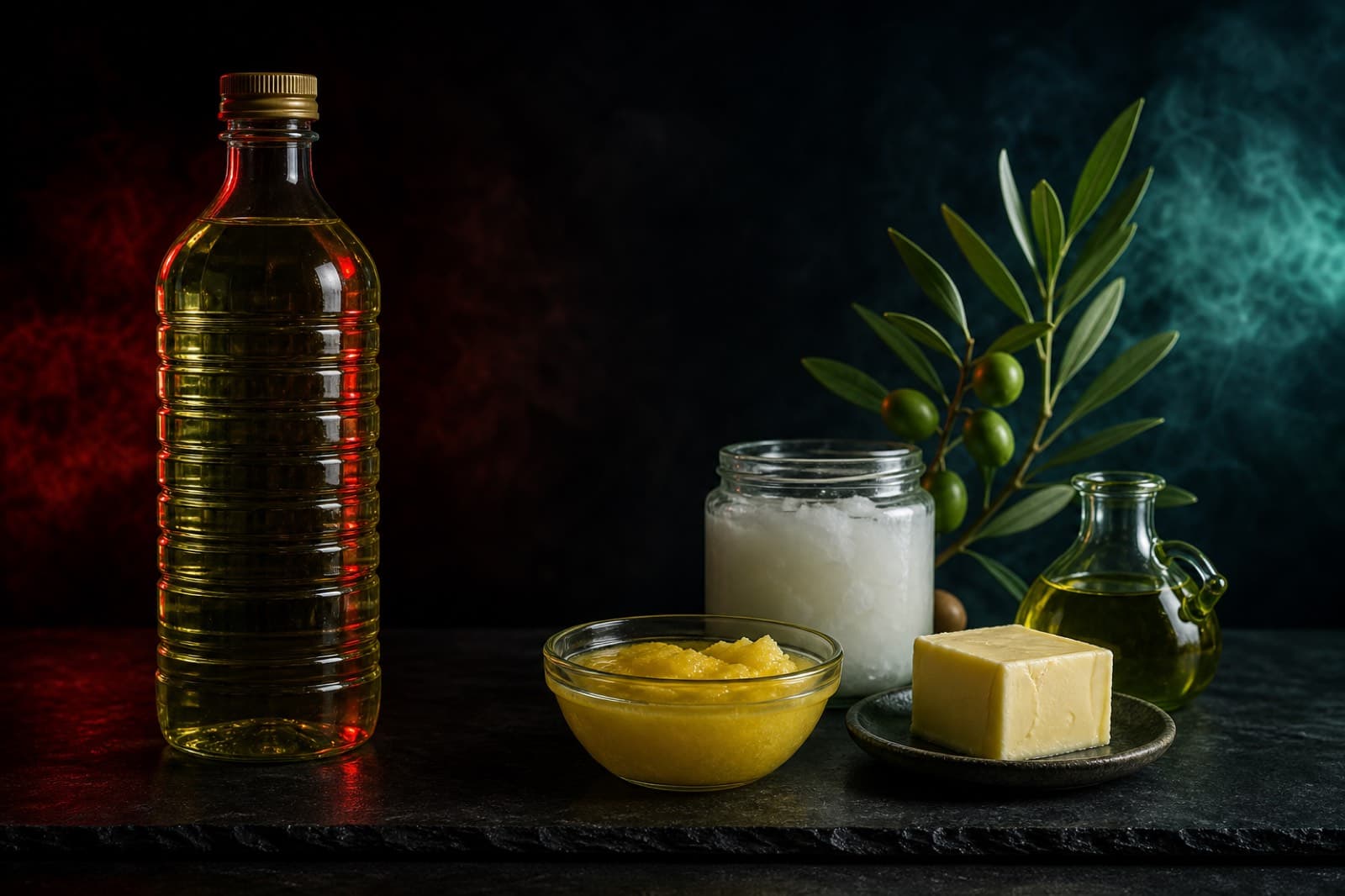
I cook with fats that are stable under heat — low in fragile PUFAs, high in saturated or monounsaturated fats:
- Extra virgin olive oil — mostly monounsaturated, rich in antioxidants. Great for low-to-medium heat and finishing. (It's more stable than its reputation suggests.)
- Butter and ghee — stable saturated fat; ghee has a high smoke point and no milk solids.
- Coconut oil — very stable saturated fat for higher-heat cooking.
- Tallow / animal fats — traditional, highly heat-stable frying fats that produce minimal oxidation products.
- Avocado oil — mostly monounsaturated with a high smoke point (buy a reputable brand; adulteration is common).
A Sane, Non-Hysterical Stance
I'm not telling you a trace of canola will ruin your physique. Here's the realistic priority order:
1. Don't cook at high heat with PUFA-rich seed oils, and avoid reused fryer oil (restaurant fried food).
2. Cut ultra-processed foods — that's where most seed oil (and most diet problems) actually come from.
3. Cook at home with stable fats — butter, ghee, olive oil, coconut, tallow.
4. Eat your omega-3s — fatty fish or a quality supplement — to improve the ratio.
Do those four and the seed-oil question mostly takes care of itself.
How It Fits Your Training
Cooking fat is a small lever, but nutrition is part of the Dark Kinetics recovery foundation behind real results — and the principle here (eat whole, minimally processed food, cook it in stable fats) is the same one that drives body composition and recovery. Pair it with the basics that actually move the needle: omega-3s to balance your fatty-acid intake, and a protein-first approach to anchor every meal.
Next: five foods where reading the label is the difference between the real thing and an expensive copy — the five counterfeits.
References
- [1]Guillén MD, Uriarte PS. “Aldehydes contained in edible oils of a very different nature after prolonged heating at frying temperature: presence of toxic oxygenated α,β-unsaturated aldehydes.” Food Chemistry, 2012
- [2]Grootveld M, Percival BC, Grootveld KL. “Chronic non-communicable disease risks presented by lipid oxidation products in fried foods.” Hepatobiliary Surgery and Nutrition, 2018
- [3]Grootveld M, Addis PB, Le Gresley A, et al. “Potential adverse public health effects afforded by the ingestion of dietary lipid oxidation product toxins: significance of fried food sources.” Nutrients, 2020
- [4]Choe E, Min DB. “Chemistry of deep-fat frying oils.” Journal of Food Science, 2007
Dark Kinetics
The five scrolls Musashi sealed at Reigandō in 1645, restored as a training doctrine and welded to cellular measurement.
Denshō
Earth, Water, Fire, Wind, Void — the doctrine this record sits inside. No consultation, no call to schedule.
OPEN THE DENSHŌ