A5 Wagyu vs American Wagyu vs Kobe: What You're Actually Buying
Nutrition
A5 Wagyu vs American Wagyu vs Kobe: What You're Actually Buying
If you are about to pay steakhouse money for something called A5 wagyu, the first thing worth knowing is this: genuine Japanese wagyu comes with a ten-digit number, and you can look up the individual animal it came from. Not the farm. Not the batch. The animal.
Almost nobody who orders it has ever been shown that number. Most were never told it exists. And the gap between what the word wagyu promises and what usually arrives on the plate is wide enough to be worth understanding exactly — because three very different products are sold under overlapping names, at prices that can differ several times over.
What "Wagyu" Actually Means
Wagyu (和牛) means, literally, Japanese cattle. It refers to four native breeds:
- Japanese Black (Kuroge Washu) — the overwhelming majority of wagyu raised in Japan, and the breed behind almost every famous name, Kobe included
- Japanese Brown (Akage Washu)
- Japanese Shorthorn (Nihon Tankaku Washu)
- Japanese Polled (Mukaku Washu)
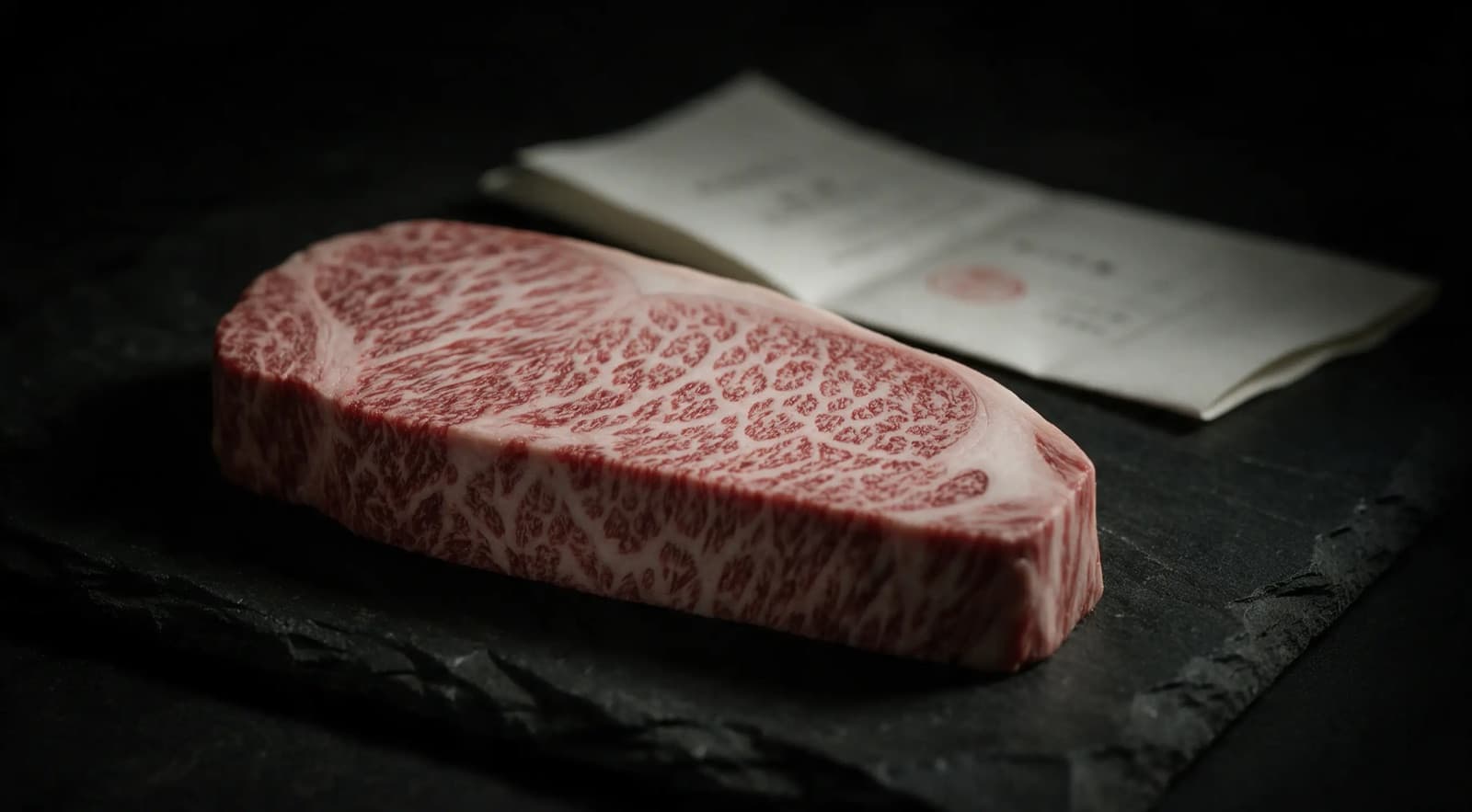
What distinguishes Japanese Black is genetic. It deposits fat inside the muscle, as fine intramuscular marbling, rather than around it. That fat is unusually high in monounsaturated fat — oleic acid in particular — which is why it melts at a lower temperature than ordinary beef fat, and why good wagyu seems to dissolve rather than chew.
That is the breed. Whether what you are buying is that breed, raised in Japan and graded in Japan, is a separate question entirely.
Japanese A5 Wagyu vs American Wagyu
Japan stopped allowing the export of live wagyu cattle and genetics in the late 1990s. The herds outside Japan descend from a small number of animals that left before then — and most of those herds have since been crossed with other breeds, overwhelmingly Angus.
That produces several distinct grades of "wagyu" outside Japan, defined by how much Japanese genetics the animal carries:
| Japanese wagyu | Fullblood wagyu | Purebred wagyu | Crossbred (F1) wagyu | |
|---|---|---|---|---|
| Wagyu genetics | 100% | 100%, traced to the Japanese registry | 93.75% or more | Around 50% |
| Raised in | Japan | Outside Japan | Outside Japan | Outside Japan |
| Graded by | Japan Meat Grading Association | Local system | Local system | Local system |
| Can be A5 | Yes | No | No | No |
| Typical label | Japanese A5 wagyu | Fullblood wagyu | Purebred wagyu | American wagyu, wagyu beef |
Most of what is sold in the West as "American wagyu" is the last column: Wagyu crossed with Angus, sold legally under that name, and often very good beef. It is simply not the same product as Japanese A5, and it is not supposed to be priced like it.
The problem is never the crossbreeding. It is a menu that says wagyu and charges for Japanese A5.
What A5 Actually Means
A5 is not an adjective, a mood, or a level of fattiness a chef can judge by eye. It is a grade issued by the Japan Meat Grading Association, to one carcass, on paper, in Japan.
It has two parts.
The letter: yield grade
A, B or C — how much usable meat the carcass yields relative to its weight. A is the highest yield.
The number: quality grade
1 to 5, judged on four separate criteria:
1. Marbling — scored on the Beef Marbling Standard, or BMS, from 1 to 12
2. Meat colour and brightness
3. Firmness and texture
4. Fat colour, lustre and quality
The detail almost nobody explains: the final quality grade is the lowest of the four. Extraordinary marbling cannot rescue a carcass whose fat is the wrong colour. A 5 has to be a 5 on everything.
For marbling specifically, a quality grade of 5 requires a BMS of 8 to 12:
| BMS | Marbling grade |
|---|---|
| 8 – 12 | 5 |
| 6 – 7 | 4 |
| 3 – 5 | 3 |
| 2 | 2 |
| 1 | 1 |
So A5 is the top of both scales: the highest yield, and the highest quality on every criterion at once.
Why "A5" on a non-Japanese label means nothing
The Japan Meat Grading Association grades cattle in Japan. An American, Australian or British label that says A5 is borrowing a grade that was never awarded.
Australian wagyu uses a different scale entirely — the AUS-MEAT marbling score, which runs from 0 to 9+. An "MS9+" label is a real Australian grade, and it can be excellent beef, but it is not A5 and should not be priced as if it were.
Wagyu vs Kobe Beef
Kobe is narrower still. All Kobe beef is wagyu. Almost no wagyu is Kobe.
To be sold as Kobe beef, an animal must be:
- Tajima-gyu — a specific bloodline of Japanese Black
- Born, raised and processed in Hyōgo Prefecture
- A heifer or a steer
- Graded to a quality score of 4 or 5, with a BMS of 6 or higher, under a set maximum carcass weight
Genuine Kobe is certified by the Kobe Beef Marketing and Distribution Promotion Association. It carries a certificate showing the animal's ten-digit identification number and a nose print, and it is stamped with the association's chrysanthemum seal — the nojigiku.
The Kobe name has been used widely abroad on beef that has never been anywhere near Hyōgo. That is exactly why the certificate exists.
How To Tell If Your Wagyu Is Real
Check one: ask for the ten-digit number
Since 2003, every head of cattle in Japan has carried a ten-digit individual identification number under the national beef traceability system. Authentic Japanese beef is traceable against that number, and the number is searchable in the National Livestock Breeding Center's database — enter it and you see the animal's date of birth, its breed, and every farm it passed through.
This is the check that settles it, and it is four words long: can you show me?
A seller with genuine Japanese beef is pleased to be asked. The paperwork is the reason the price is what it is. A seller who bristles, changes the subject, or says the number is not something they keep has just answered you.
Check two: ask what the BMS was
Genuine Japanese wagyu carries its grade. Ask what the marbling score was. A seller who knows will give you a number between 8 and 12. A seller who says "it's A5" and nothing more is repeating a word.
Check three: the price
Japanese A5 is expensive at every stage — breeding, years of feeding, export certification, air freight. If it is offered for the price of a good ribeye, something in the chain is not what it claims to be. A high price is not proof of authenticity. A price that is too low is very close to proof of the opposite.
Check four: marbling that is too even
Real marbling is irregular — a natural network that differs from cut to cut. Fat-injected beef exists: lean beef with fat injected into it to imitate marbling. In Japan it has to be labelled as processed. Elsewhere it can turn up looking like wagyu. Marbling that looks geometrically uniform, or identical across every steak in a pack, deserves a question.
Why Marbling Alone Proves Nothing
Beautiful marbling is what you are looking at when you are being sold something. The paper is what you are looking at when you are buying something.
Marbling can be bred for outside Japan, imitated by injection, and photographed flatteringly by anybody. A ten-digit number tied to an entry in a national database cannot. That asymmetry is the whole method: ignore what can be faked, and ask for what cannot.
Frequently Asked Questions
Is American wagyu real wagyu?
It carries real wagyu genetics — usually around half, from Wagyu crossed with Angus. It is legally sold as wagyu and is often excellent beef. It is not Japanese wagyu, it cannot be graded A5, and it should not be priced as though it were.
What does A5 wagyu mean?
A5 is the top grade awarded by the Japan Meat Grading Association: A for the highest carcass yield, and 5 for the highest quality, which requires a marbling score of 8 to 12 and top marks for colour, texture and fat quality.
Is Kobe beef the same as wagyu?
Kobe is one specific kind of wagyu — Tajima-gyu raised in Hyōgo Prefecture and certified to a defined standard. All Kobe is wagyu. Very little wagyu is Kobe.
What is the best grade of wagyu?
A5 with a BMS of 12 is the top of the Japanese scale. Higher marbling is not automatically better to eat, though. Many people find BMS 8 to 10 more balanced than 12, which can be overwhelmingly rich.
How can I check if wagyu is real?
Ask for the ten-digit individual identification number and the grade. Genuine Japanese wagyu is traceable to a single animal, and the number can be looked up.
The Five Counterfeits
Wagyu is one of five Japanese foods where the substitution is routine and the check is simple.
Matcha sold as ceremonial when it is culinary powder, sometimes coloured to look the part — how to tell real ceremonial matcha.
Gyokuro sold under the name when it was never shaded long enough to earn it.
Katsuobushi sold as arabushi at the price of karebushi — the same fish, at a far earlier and cheaper stage of its making.
Natto sold with a sachet that is mostly sugar.
Five substitutions, five checks, each doable standing in a shop: the five counterfeits.
Where The Sourcing Itself Lives
Knowing something is fake is half the problem. The other half is knowing where the real thing is bought — which producers, what a fair price looks like, and what the paperwork should say before you order.
That is the Sourcing Ledger, inside 和食 Washoku Longevity, alongside the counterfeit chapter in full and the same treatment applied to matcha, gyokuro, katsuobushi and kombu.
Summary
- Wagyu means Japanese cattle — four breeds, overwhelmingly Japanese Black.
- Most Western "wagyu" is crossbred, usually around 50% Wagyu over Angus. Legal, often good, not Japanese.
- A5 is a Japanese grade: highest yield, highest quality, BMS 8 to 12, top marks on all four criteria.
- A5 cannot be awarded outside Japan. An A5 label on non-Japanese beef is borrowing a grade.
- Kobe is Tajima-gyu from Hyōgo, certified, with a nose print and a ten-digit number.
- The check is four words: can you show me? Genuine Japanese beef is traceable to one animal.
Next: the other four counterfeits, each with a check you can do standing in a shop — the five counterfeits.
Dark Kinetics
The five scrolls Musashi sealed at Reigandō in 1645, restored as a training doctrine and welded to cellular measurement.
Denshō
Earth, Water, Fire, Wind, Void — the doctrine this record sits inside. No consultation, no call to schedule.
OPEN THE DENSHŌ