Ceremonial Grade Matcha: What the Label Means, and How to Tell Real From Dyed
Nutrition
Ceremonial Grade Matcha: What the Label Means, and How to Tell Real From Dyed
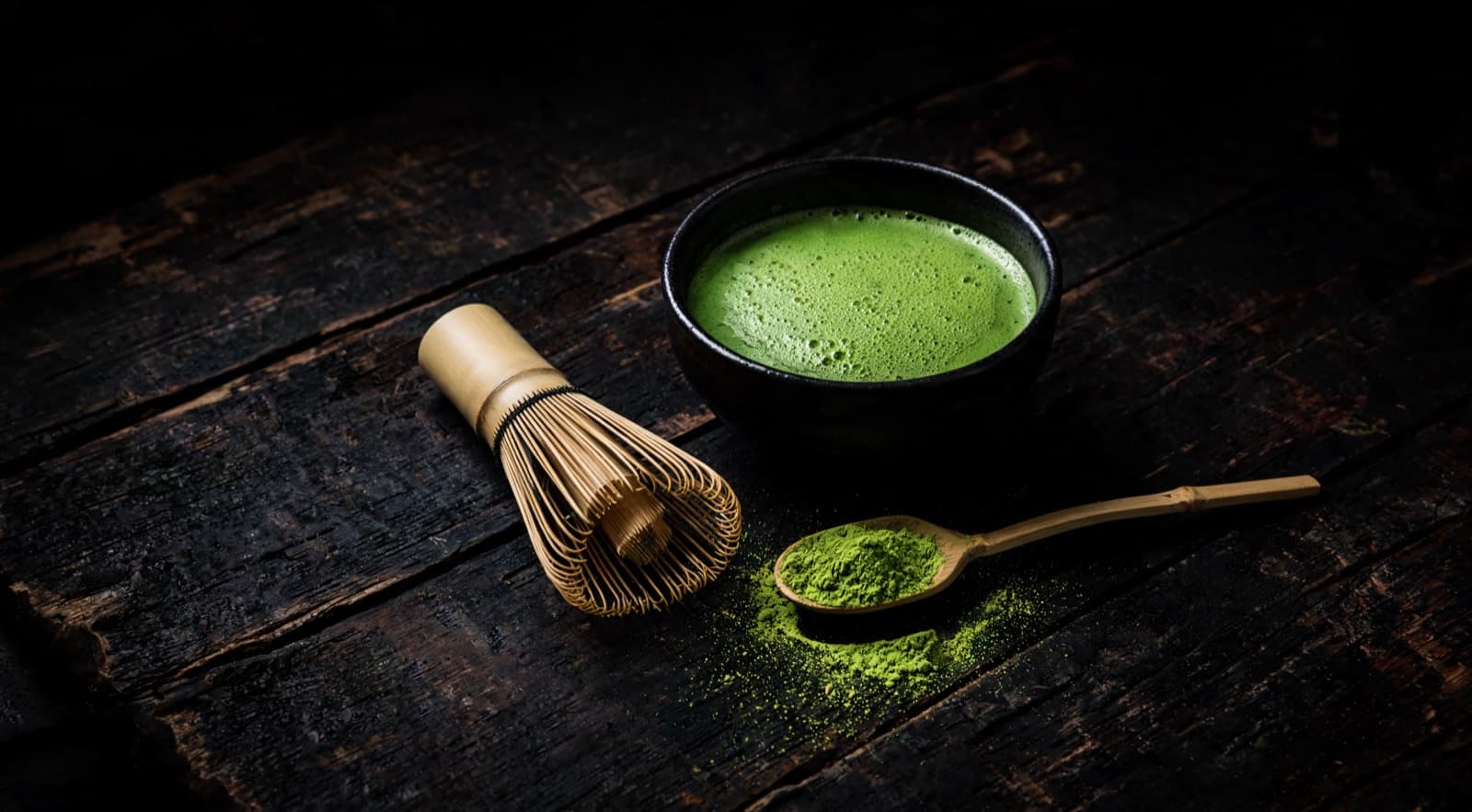
If you are about to spend forty pounds on a thirty-gram tin, the first thing worth knowing is this: "ceremonial grade" is not a regulated term. There is no Japanese authority that certifies it, no inspection behind it, and no penalty for printing it on anything green. It is a marketing phrase invented for Western shelves.
That does not make it meaningless. It points at something real — the tea used in chadō, the way of tea codified by Sen no Rikyū in the sixteenth century and carried since by three unbroken family schools: Omotesenke, Urasenke and Mushakōjisenke. The ceremony is four hundred and fifty years old and still practised daily. The label is about thirty years old and practised by anyone with a printer.
So the question is not whether a tin says ceremonial grade. It is whether what is inside it was made the expensive way.
What Actually Separates Ceremonial From Culinary Matcha
Four things, and every one of them costs the grower money.
1. Shade, for about three weeks before harvest
Tea destined to become matcha is covered — traditionally with rice straw over a bamboo frame, now usually with synthetic shade cloth — for roughly twenty days before picking. Blocking most of the sunlight forces the plant to produce more chlorophyll to compensate.
Two things follow. The leaf turns a deep, almost unnatural green. And the amino acid L-theanine, which would otherwise convert to catechins under sunlight, stays in the leaf. That is where the sweetness and the thick, almost broth-like body of good matcha come from.
Shading also costs the farmer a substantial share of the crop's yield. That cost is the entire reason the check below works.
2. First harvest, not the third
Japanese tea is picked in flushes across the season. The first, ichibancha, comes in late April and May and carries the highest concentration of the compounds shading produced. Second and third flushes are coarser, more astringent, and dramatically cheaper.
Ceremonial grade should be first harvest. Culinary grade routinely is not, and does not say so.
3. Tencha, de-veined and de-stemmed
Shaded leaf is steamed, dried without rolling, and becomes tencha. Before milling, the veins and stems are removed. What remains is leaf flesh only.
Skipping that step is one of the commonest economies in cheap matcha. Vein and stem grind into the powder, and they taste bitter and sit grey-green rather than jade.
4. Stone-milled, slowly
Traditional granite mills produce roughly thirty to forty grams an hour. Not per minute. Per hour. The slowness matters because friction generates heat, and heat degrades both the aroma and the colour.
Ball-milled or roller-milled powder is produced in a fraction of the time at a fraction of the cost. It is not fraudulent, but it is not what a ceremonial price is buying.
The Three Checks That Expose A Fake
None of these require equipment, a laboratory, or a second opinion. Each one tests an expensive step a counterfeit skips — which is why they cannot be faked cheaply.
Check one: the colour, in daylight
Take the powder to a window. Not under kitchen light, which flatters everything.
Vivid jade, almost luminous — first harvest, properly shaded.
Olive, khaki, or yellow-green — a later flush, insufficient shading, or stem in the grind.
Dull and slightly grey — oxidised. Matcha degrades fast once ground and faster once opened.
A tin you cannot see into before buying is asking you to take its word.
Check two: the price, per gram
Work out the price per gram rather than per tin, because tin sizes are chosen to obscure comparison.
Genuine first-harvest, stone-milled matcha sits at roughly £1 per gram and upward at the time of writing. Below that, the arithmetic does not work: the shading has cost yield, the milling has cost hours, and somebody in the chain has taken a margin.
Cheap matcha is not a bargain on good matcha. It is a different product.
Check three: how it behaves in water
Sift two grams, add seventy to eighty millilitres of water at 70–80°C, and whisk in a W motion for about fifteen seconds.
Real ceremonial matcha suspends into a fine, stable foam with a sweetness that arrives before the bitterness. It separates if you leave it, which is why it is drunk at once.
Culinary powder brewed the same way stays thin, foams poorly, and leads with astringency.
One warning that catches most people: if you brew with boiling water, everything tastes bitter and you have destroyed your own test. Matcha is not black tea. The water must be below boiling, and the better the matcha the cooler the water.
Why Colour Correction Is The Deception That Matters
The most common adulteration in Western retail is not an additive. It is selection and presentation — later-harvest leaf, sometimes with stem, packaged in opaque tins with photography that has been colour-graded toward jade.
Some powders are also blended with other green material, or with a small proportion of genuine first-harvest matcha to lift the colour of a cheap base.
This is difficult to legislate against precisely because "ceremonial grade" defines nothing. Which returns the burden to the buyer, and is exactly why the checks above are worth memorising.
What About Origin Labels?
Uji, south of Kyoto, is the most cited origin, and the region where shade-growing was developed. Nishio in Aichi and Yame in Fukuoka are also serious.
But note what a region name on a tin does and does not tell you. It is not a controlled designation in the way wine appellations are. Blending across regions is common and legal, and "Uji matcha" may denote blending or processing in Uji rather than growing there.
Origin is a weak signal. Colour, price per gram and behaviour in water are strong ones.
A Short Note On What This Article Is Not
This is a piece about grading, labelling and provenance — what a thing is, how it is made, and how it is sold. It makes no claim about what matcha does to a body, and nothing here should be read as health advice or as a suggestion that any food prevents or treats a condition.
Plenty has been written about matcha and health. Very little has been written about whether the tin in your hand contains what it says, which is the question you have to answer first and the only one this article addresses.
The Five Counterfeits
Matcha is the most widely faked of the Japanese fuels, but it is not the only one.
A5 wagyu sold in the West is frequently neither A5 nor Japanese — wagyu names a breed, not an origin, and genuine Japanese beef carries a ten-digit individual identification number and a JMGA grade certificate traceable to the animal.
Gyokuro is the most routinely mislabelled tea in the West, because sencha in a sealed packet looks identical, and only a cool brew at 50–60°C separates them.
Katsuobushi is sold bulked with additives, or as arabushi at the price of karebushi — the same fish at a far earlier and cheaper stage of its making.
Natto is sold with a sachet that is mostly sugar, or frozen so long the culture no longer builds threads.
Five substitutions, five checks, each doable standing in a shop: the five counterfeits.
Where The Sourcing Itself Lives
Knowing something is fake is half the problem. The other half is knowing where the real thing is bought — which producers, which grades, what a fair price band actually looks like by region, and what the paperwork should say before you order.
That is the Sourcing Ledger, and it sits inside 和食 Washoku Longevity with the codex, the counterfeit chapter in full, the preparation films and the whole thing read aloud.
The checks above are yours either way, and they do not expire.
Summary
- "Ceremonial grade" is unregulated. Anybody may print it.
- What actually costs money: three weeks of shade, first harvest, de-veined tencha, slow stone milling.
- Colour in daylight — vivid jade, not olive.
- Price per gram — below roughly £1/g the arithmetic does not work.
- 70–80°C, never boiling. Brewing hot destroys your own test.
- Origin labels are a weak signal. Blending is common and legal.
Dark Kinetics
The five scrolls Musashi sealed at Reigandō in 1645, restored as a training doctrine and welded to cellular measurement.
Denshō
Earth, Water, Fire, Wind, Void — the doctrine this record sits inside. No consultation, no call to schedule.
OPEN THE DENSHŌ