Nordic Curl vs Leg Curl: Which Builds Better Hamstrings?
Training
Nordic Curl vs Leg Curl: Which Builds Better Hamstrings?
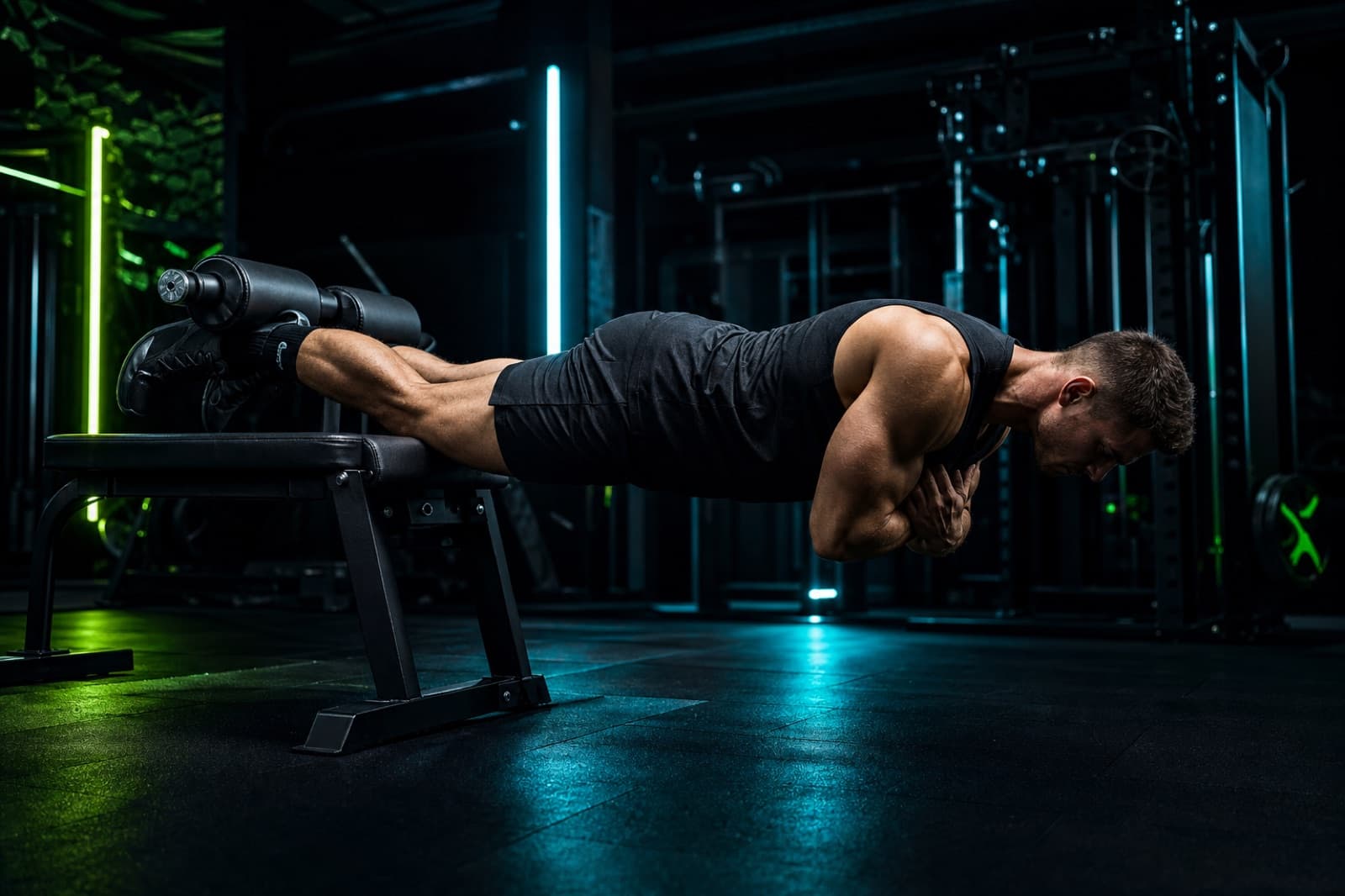
If you search "hamstring exercises," the leg curl machine wins by volume. It's everywhere, it's easy, and it burns the back of your thighs. If you search what actually builds eccentric knee-flexor strength — the quality linked to sprinting, deceleration, and hamstring resilience in field sports — the answer keeps pointing to one movement: the nordic hamstring curl.
So which should you train? Both can have a place. But they are not interchangeable. Treat them like the same exercise and you'll either stay fragile at speed or leave muscle on the table.
This guide breaks down nordic curl vs leg curl for athletes: biomechanics, evidence, programming, setup without a nordic bench, and the mistakes that keep people doing leg curls for years while still pulling hamstrings every season.
Quick Answer
| Nordic curl | Leg curl machine | |
|---|---|---|
| Primary stimulus | Eccentric knee flexion at long muscle lengths | Concentric knee flexion (most machine versions) |
| Equipment | Bodyweight + anchor (partner, barbell, strap) | Machine |
| Best for | Deceleration, sprinting, cutting, nordic progressions | Muscle growth, beginner access, higher volume |
| Evidence for injury resilience | Strongest in pooled sports-science literature | Weaker for eccentric / long-length demands |
| Difficulty | High — needs regressions | Low — sit down and curl |
Athletes who sprint, jump, or change direction: nordics (or regressions) are non-negotiable eventually. Bodybuilders or general lifters chasing hamstring size: leg curls are a useful tool — not the whole story.
They Are Not the Same Exercise
The confusion starts with the name. Both are "hamstring curls." The mechanics could not be more different.
Leg curl machine
- Open-chain — your foot moves, hips usually fixed on a pad
- Concentric-biased — most people curl up hard and drop the weight on the way down
- Short-to-mid muscle lengths — peak tension often isn't where hamstrings get injured at speed
- Easy to load and progress — pin weight, add load, track numbers
Leg curls build hamstring size and concentric strength. That matters. But the machine does not automatically train you to brake at long lengths — the exact demand when you sprint, land from a jump, or get tackled.
Nordic hamstring curl
- Closed-chain, bodyweight-first — knees fixed, torso moves through space
- Eccentric-dominant — you fight gravity on the way down; the lowering is the whole point
- Long muscle lengths — hamstrings under maximal lengthening tension near end range
- Hard to fake — momentum and hip folding turn it into a lower-back exercise instantly
Nordics train knee flexion while the hamstrings are stretched — the pattern field sports actually need. That is why they show up in hamstring injury-prevention programs across football, rugby, and track, not because influencers invented them last year.
What the Research Actually Says
We are not claiming nordics "cure" injuries — that is a medical claim. The training literature is clearer on this than training-floor culture:
- Systematic reviews of nordic-based programs report meaningful reductions in hamstring strain incidence in team-sport populations when programs are actually followed — not when athletes do three sloppy efforts once a month.
- Eccentric strengthening at long lengths increases fascicle length and eccentric force capacity — mechanical qualities associated with hamstring strain risk in sprinting and high-speed running.
- Leg curls have a long bodybuilding history and clear muscle-growth value, but machine leg curls alone have not replicated the same injury-prevention track record as structured nordic progressions in team-sport trials.
Translation: if your only hamstring work is three rounds on the leg curl machine, you are training one function (concentric knee flexion in a supported position) and hoping it covers deceleration at speed. It usually does not.
For the full staged progression — foundation through end-range control — see our nordic progression guide.
The Two Hamstring Jobs (Why "Leg Day" Fails Athletes)
Your hamstrings do two jobs:
1. Hip extension — sprinting, jumping, deadlifting (RDLs, hip thrusts, GHR)
2. Knee flexion under eccentric load — landing, cutting, nordics
Leg curls hit knee flexion — mostly concentric. Nordics hit knee flexion — mostly eccentric at long length. Most programs over-index on hip extension and skip knee flexion entirely.
Both of these load a hamstring. Neither asks whether the knee above it and the ankle below it are doing their own jobs — and a hamstring compensating for a stiff ankle will not be fixed by loading the hamstring harder. The five positions, ground upward, with the compensation to watch on each.
That is why a lifter can deadlift serious weight and still gas out on the first effort of a nordic negative. Different demand. Different adaptation.
Nordic Curl Form: What Actually Counts
An effort only counts if:
- Hips stay extended — ribs down, glutes squeezed, no folding into a good morning
- Movement is knee-driven — you lengthen at the knee, not by dumping through the hips
- Eccentric is controlled — 3–5 seconds on the way down for most progressions; no freefall
- Return is intentional — hamstring-driven push back, no hand assistance during the working effort
- Box targets in Phases 1–3 — lower only as far as you can control; contact the box under control, reset kneeling after contact
Phase 7 performance standard: 3×6 perfect full nordics — controlled 4-second eccentric → 3-second glute squeeze at bottom → clean bodyweight return. That is the Dark Kinetics standard achievement checkpoint.
Tempered (after the phase standard): 3×10 perfect full nordics — the highest standard in the sequence, not required to hold the phase. Weighted work beyond it is optional, never part of the required path.
Setup without a nordic bench
You do not need a $800 nordic bench. You need heels locked and knees padded:
- Barbell loaded in a rack as an ankle anchor (our default)
- Partner holding ankles (classic)
- Strap or landmine anchor at home
If "no nordic bench" is your excuse, fix the setup — not the exercise.
Leg Curl Form: Get Something Useful From the Machine
Leg curls are not useless. They are misused.
Do this:
- Control the eccentric — 2–3 seconds down, do not drop the stack
- Full range without lumbar arching off the pad
- Moderate loads for 8–15 repetitions when size is the goal
- Treat it as an accessory, not your entire hamstring strategy
Skip this:
- Swinging the weight up with momentum
- Using leg curls as your only hamstring exercise while playing a cutting sport
- Chasing a stack PR while your nordic negative lasts 0.8 seconds
Nordic Curl vs Leg Curl: Who Should Prioritize What?
Prioritize nordics (or regressions) if you:
- Sprint, jump, or cut in your sport
- Have a history of hamstring strains
- Want posterior-chain work that transfers to landing and reactive jump training
- Already hip-hinge strong but weak on eccentrics
Prioritize leg curls if you:
- Are brand new to training and cannot yet control a high-box Nordic eccentric
- Want direct hamstring size with simple load progression
- Are rehabbing under a physio who has prescribed open-chain knee flexion
- Need a low-skill finisher after your main hinge work
Do both if you:
- Train hamstrings twice per week (our preference for most athletes)
- Want size and eccentric resilience — different sessions, different jobs
Sample Weekly Split (Athlete-Focused)
Day A — Eccentric / nordic emphasis
- Nordic progression (your current week in the system): 3–4 × 3–6
- RDL or single-leg RDL: 3–4 × 6–8
- Optional: light leg curl, slow eccentric, 2 × 12
Day B — Hip extension + volume
- Hip thrust or GHR: 3–4 × 6–10
- Leg curl machine (controlled): 3 × 10–12
- Sprint, jump, or sport work as programmed
Space nordic days at least 48 hours apart. Hamstrings need recovery from true eccentric work — stacking nordics, depth jumps, and heavy RDLs on consecutive days is how people blame the exercise instead of the schedule.
This mirrors the structure of the scrolls — not random nordics when you "feel like it," but a sealed order where each stage opens only once the one beneath it is tempered.
The 5 Mistakes That Keep Leg Curls Winning (and Athletes Losing)
1. Replacing nordics with leg curls — different stimulus, different outcome
2. Skipping regressions — full nordics on week one before box eccentrics and eccentric mastery, quit forever
3. Rushing the eccentric — the lowering is the adaptation; speed down kills the point
4. Hip folding — turns the best hamstring exercise into a lower-back gamble
5. No progression logic — the same three rounds forever, no gates, no tempo prescription
Generic leg days — squat, press, curl, calf raise — build muscle. They do not build the eccentric brake that sport demands. Nordics are the missing layer for most machine-trained athletes.
Nordic Curl vs Leg Curl: FAQ
Are nordic curls the same as hamstring curls?
No. Same muscle group, different mechanics. Leg curls are usually machine-based and concentric-biased. Nordics are bodyweight-first and eccentric-dominant at long lengths.
Can leg curls replace nordics?
For size, partially. For eccentric strength at lengths where hamstrings fail at speed — no. If you play a running or cutting sport, you need eccentric knee-flexion work eventually.
How often should I do nordics?
Most athletes: 2× per week, moderate volume (3–4 rounds of 3–6 quality efforts). More is not better if form breaks.
Why can I leg curl heavy but not do one nordic?
You have trained concentric knee flexion and hip extension — not lengthened eccentric knee flexion. That is normal. Start at high-box eccentrics, not ego.
Nordic curl vs GHD hamstring curl?
GHD work blends hip extension and knee flexion — excellent accessory. Nordics remain the gold standard for pure eccentric knee flexion at end range. Use both in a complete posterior-chain system.
Bottom Line
Leg curl machines win training floors because they are easy. Nordic curls win the conversation on eccentric hamstring strength because they are hard — and specific.
If you are an athlete, build toward nordics the same way you build toward a heavy squat: regressions, tempo, gates, consistency. Use leg curls as a tool for volume and size — not as a substitute.
The doctrine this sits inside is the Water scroll — end-range control through full arcs, where strength that exists only in the middle of a range is not strength but a habit. Denshō carries the full form.
Train both functions. Earn the eccentric. Stop hoping leg curls alone will save you at max speed.
Next: the joint above it and the joint below it, in fixed order — the five positions.
References
- [1]Petersen J, Thorborg K, Nielsen MB, et al. “Preventive effect of eccentric training on acute hamstring injuries in men's soccer: a cluster-randomized controlled trial.” American Journal of Sports Medicine, 2011
- [2]van der Horst N, Smits DW, Petersen J, et al. “The preventive effect of the Nordic hamstring exercise on hamstring injuries in amateur soccer players: a randomized controlled trial.” American Journal of Sports Medicine, 2015
- [3]Al Attar WSA, Soomro N, Sinclair PJ, et al. “Effect of injury prevention programs that include the Nordic hamstring exercise on hamstring injury rates in soccer players: a systematic review and meta-analysis.” Sports Medicine, 2017
- [4]Bourne MN, Duhig SJ, Timmins RG, et al. “Impact of the Nordic hamstring and hip extension exercises on hamstring architecture and morphology.” British Journal of Sports Medicine, 2017
Dark Kinetics
The five scrolls Musashi sealed at Reigandō in 1645, restored as a training doctrine and welded to cellular measurement.
Denshō
Earth, Water, Fire, Wind, Void — the doctrine this record sits inside. No consultation, no call to schedule.
OPEN THE DENSHŌ