Infrared vs Finnish Sauna: Which Is Better for Recovery?
Recovery
Infrared vs Finnish Sauna: Which Is Better for Recovery?
Heat is one of the most underrated recovery tools in sport. Not because it's exotic — because it's consistent. Regular sauna use is one of the few recovery habits with serious long-term human data behind it, from endurance performance all the way to cardiovascular and all-cause mortality.
But "sauna" isn't one thing. An infrared cabin and a traditional Finnish sauna heat your body through completely different physics, hit different temperatures, and feel nothing alike. This guide breaks down what each one actually does, what the research supports, and which one to buy as an athlete.
Disclosure: Partner links below (SaunaKits, Therasage). I earn commission on qualifying purchases. I only recommend what I'd use myself.
The Core Difference: How Each One Heats You
This is the whole game. Everything else follows from it.
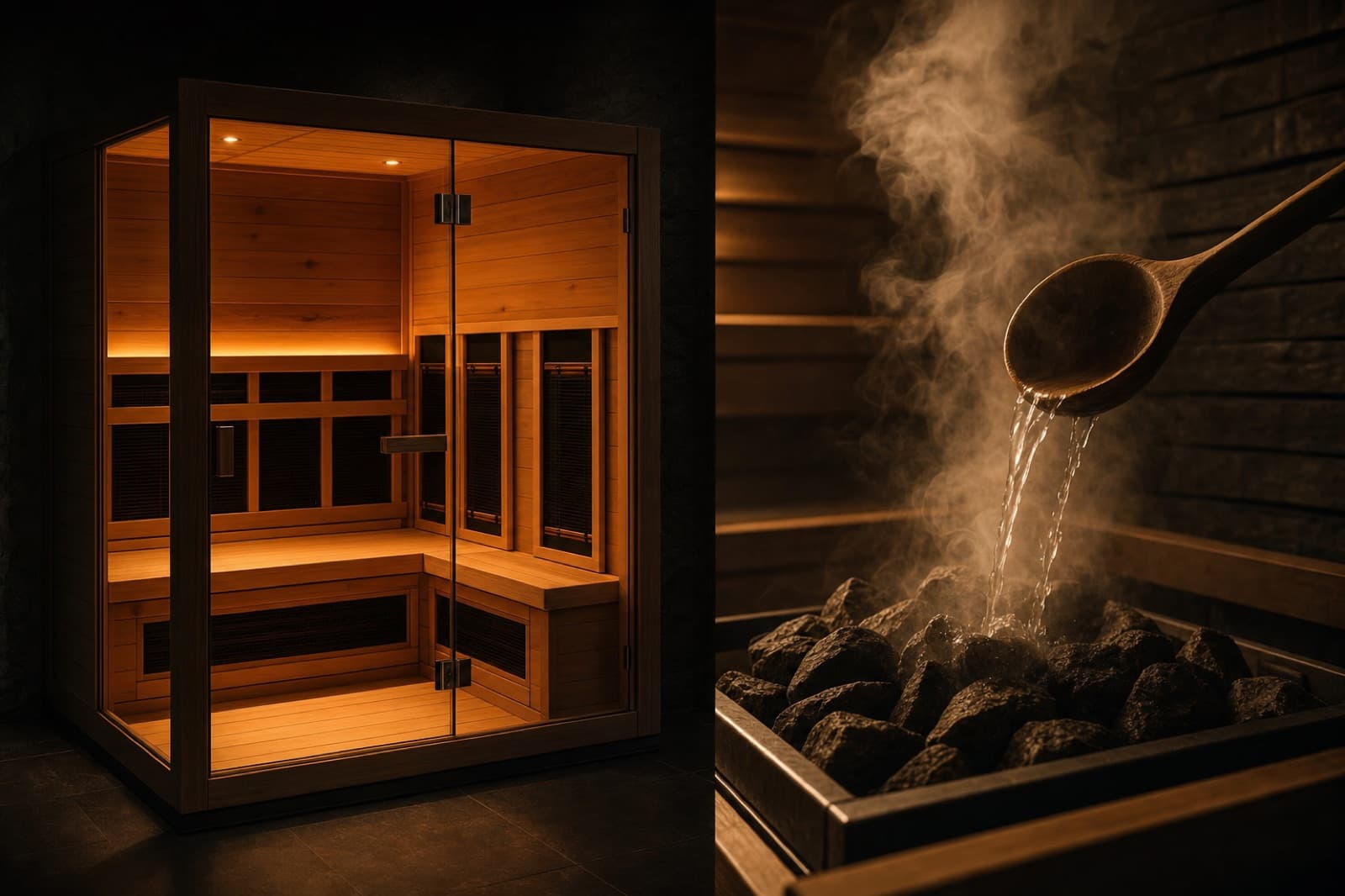
Traditional Finnish sauna heats the air. An electric or wood heater warms rocks, the rocks heat the room to 70–100°C (160–210°F), and that hot air heats your skin. Throw water on the rocks (löyly) and humidity spikes, which makes the heat feel even more intense. You sweat because the environment around you is genuinely, brutally hot.
Infrared sauna heats you, not the air. Infrared emitters give off radiant heat that your body absorbs directly — the same way the sun warms your skin on a cold day. The cabin air stays much cooler (45–60°C / 110–140°F), but your core temperature still climbs and you still sweat, just at a lower air temperature.
Neither is "fake." They're two routes to the same destination: raised core temperature, increased blood flow, and a sweat response. They just get there differently — and that difference decides which one suits you.
What the Research Actually Shows
Here's the important nuance: almost all of the long-term sauna research was done on traditional Finnish saunas, because that's what Finland has used for centuries. So the strongest evidence is for traditional heat — infrared rides on the general "heat exposure" mechanism but has far less long-term data.
The headline findings, all from traditional sauna studies:
- Cardiovascular and all-cause mortality: In a 20-year study of 2,315 men, those using a sauna 4–7 times per week had roughly half the cardiovascular mortality and 40% lower all-cause mortality compared with once-a-week users.
- Stroke risk: 4–7 sessions per week were linked to a 61% lower stroke risk versus one session, independent of standard risk factors.
- Endurance performance: Three weeks of post-run sauna sessions increased plasma volume and improved running time-to-exhaustion by ~32% — real heat acclimation that transferred to performance.
- Overall: A systematic review of 40 studies found regular dry sauna use associated with cardiovascular, blood-pressure, and recovery benefits, with few adverse events in healthy people.
The honest read: these are mostly observational (people who sauna a lot may be healthier in other ways), but the consistency, dose-response, and a few intervention studies make the case strong. The mechanism — repeated mild heat stress that improves vascular function — is well-supported.
Infrared vs Finnish: Head to Head
Heat intensity & feel
- Finnish: Intense, enveloping, "real sauna" heat. The löyly steam hit is part of the appeal. Some people love it; some can't tolerate it long.
- Infrared: Gentler air, longer comfortable sessions. Easier if you dislike harsh heat or want to read/breathe through 30–40 minutes.
Time to sweat
- Finnish: Heats the room fast once warmed up; you sweat quickly in the high air temp.
- Infrared: Slower warm-up, more gradual sweat — but a deep one once your core climbs.
Energy & install
- Finnish: Higher power draw, often needs more ventilation; classic for outdoor cabins.
- Infrared: Lower power, plugs into standard outlets in many models, fits indoors and into small footprints.
Evidence
- Finnish: The bulk of the long-term human data.
- Infrared: Shares the heat-stress mechanism but has thinner long-term research. Promising, not proven to the same degree.
Which Should You Buy?
It comes down to tolerance, space, and budget — not one being magic.
Pick infrared if…
You want gentler heat, longer comfortable sessions, an indoor unit, lower running cost, and an easier install. It's the most accessible entry into daily heat.
My pick for a no-permanent-install indoor option is a portable infrared cabin:
For a corner-fit cedar infrared cabin with near-zero EMF when you've got a bit more space:
Heat and cold are distinct apparatus doing distinct things, and the order matters more than the total. What contrast actually costs to run, and the week it becomes permitted.
Pick traditional (or hybrid) if…
You want the classic Finnish experience, the steam, and the modality with the most long-term data behind it — and you have the space and budget for a real cabin.
The smartest middle path for most athletes is a hybrid that does both — infrared warmth and traditional steam in one cabin, so you're never locked into one type:
And for a serious outdoor setup built to handle daily use:
Full specs and the complete heat + cold lineup live on the gear page:
How to Use a Sauna for Recovery
Type matters less than consistency. The protocols that produced the research results were simple and repeated:
- Frequency: The mortality and stroke benefits showed up at 4–7 sessions per week. Even 2–3 is a strong start.
- Duration: 15–20 minutes for traditional heat; 25–40 minutes for infrared (lower air temp, longer session).
- Timing: Post-training or evening. For pure performance/heat acclimation, after endurance work. To wind down, in the evening — heat then a natural temperature drop helps sleep.
- Hydrate: You're losing real fluid and electrolytes. Drink before and after; add electrolytes on heavy-sweat days.
- Contrast (optional): Heat → cold plunge → warm shower is my loop 4–5× per week on hard blocks. Cold immediately after a muscle-growth session may blunt some adaptation, so separate cold from your muscle-building sessions if size is the goal.
Safety: Skip the sauna if pregnant, acutely ill, or with uncontrolled cardiovascular disease without medical clearance. Don't combine with alcohol. Start conservative and build tolerance.
How This Fits Dark Kinetics
Recovery capacity sets the ceiling on how much training you can absorb. Heat is a foundational layer in the full recovery stack — sitting just below sleep and nutrition in ROI. Get those three right before you spend on PEMF mats and gadgets.
Bottom Line
Infrared heats you directly at lower air temperatures — gentler, cheaper to run, easier to install. Traditional Finnish heats the air — more intense, with the deepest long-term research behind it. A hybrid gives you both.
For most athletes building a home setup, a hybrid or infrared cabin used consistently 3–5× per week beats agonizing over which is theoretically superior. The best sauna is the one you'll actually sit in, often.
Next: the arithmetic of running heat and cold for twelve weeks — what it actually costs.
References
- [1]Laukkanen T, Khan H, Zaccardi F, Laukkanen JA. “Association between sauna bathing and fatal cardiovascular and all-cause mortality events.” JAMA Internal Medicine, 2015
- [2]Scoon GS, Hopkins WG, Mayhew S, Cotter JD. “Effect of post-exercise sauna bathing on the endurance performance of competitive male runners.” Journal of Science and Medicine in Sport, 2007
- [3]Hussain J, Cohen M. “Clinical Effects of Regular Dry Sauna Bathing: A Systematic Review.” Evidence-Based Complementary and Alternative Medicine, 2018
- [4]Kunutsor SK, Khan H, Zaccardi F, Laukkanen T, Willeit P, Laukkanen JA. “Sauna bathing reduces the risk of stroke in Finnish men and women: A prospective cohort study.” Neurology, 2018
Dark Kinetics
The five scrolls Musashi sealed at Reigandō in 1645, restored as a training doctrine and welded to cellular measurement.
Denshō
Earth, Water, Fire, Wind, Void — the doctrine this record sits inside. No consultation, no call to schedule.
OPEN THE DENSHŌ