Blue Light, Sleep & Blue-Blocking Glasses: What Actually Works
Recovery
Blue Light, Sleep & Blue-Blocking Glasses: What Actually Works
Sleep is where training adaptation actually happens. Growth hormone pulses, tissue repairs, the nervous system resets. Wreck your sleep and you blunt everything you built under load that day.
One of the easiest ways modern life wrecks sleep is light — specifically, blue light hitting your eyes after sunset. This is the honest guide to what blue light does, when blue-blocking glasses genuinely help, and the part most people get wrong (hint: it's about timing, not wearing blockers all day).
Disclosure: Partner links below (Therasage). I earn commission on qualifying purchases. I only recommend what I'd use myself.
What Blue Light Actually Does to Your Body Clock
Your brain has a master clock that uses light to decide whether it's day or night. Special cells in your eyes (intrinsically photosensitive retinal ganglion cells, or ipRGCs) are most sensitive to short-wavelength blue light — roughly 460–480 nm, the exact range pumped out by phones, laptops, TVs, and LED bulbs.
When blue light hits those cells in the evening, your brain reads it as "still daytime" and does two things:
1. Suppresses melatonin — the hormone that makes you sleepy.
2. Delays your circadian clock — pushing your natural sleep timing later.
The result: you take longer to fall asleep, your sleep is shallower, and you're groggier the next morning. In one well-known study, reading on a light-emitting device before bed suppressed melatonin, delayed the body clock, lengthened time-to-sleep, and reduced next-morning alertness compared with reading a print book. A systematic review confirmed evening short-wavelength light delays circadian phase and suppresses melatonin in a dose- and wavelength-dependent way.
For an athlete, that's not a minor inconvenience — it's a direct tax on recovery.
Do Blue-Blocking Glasses Actually Work?
Here's where you need the honest version, because the marketing oversells it.
For evening sleep and circadian protection: yes, the evidence is real.
- In a randomized controlled trial, people with insomnia who wore amber blue-blocking glasses in the hours before bed slept better than those wearing clear placebo lenses.
- An earlier randomized trial found amber lenses worn 3 hours before sleep significantly improved both sleep quality and mood versus control lenses.
- Wearing short-wavelength-blocking glasses in the evening for two weeks raised nighttime melatonin by around 58% and improved self-reported sleep.
For all-day "computer glasses": the evidence is weak.
- A systematic review found little evidence that blue-blocking lenses worn during daytime screen use reduce eye strain or protect macular health.
So the takeaway is about timing: blue-blockers earn their keep in the evening, to protect your circadian rhythm and sleep. Wearing them all day to "reduce eye strain" isn't well supported — and during the day you actually want bright light, including blue, to keep your clock anchored.
Evening light and cold exposure pull on the same autonomic machinery from opposite ends. What the cold end costs to run properly.
The Right Way to Manage Light (Cheapest First)
Glasses are one tool, not the only one. Do these in order — the first ones are free:
1. Get bright light in the morning (free)
Morning daylight advances your clock and makes evening melatonin release earlier. Get outside within an hour of waking — even 10 minutes helps. This matters as much as blocking light at night.
2. Dim and warm your environment after sunset (free)
Drop overhead lights. Use warm lamps. Set phones/laptops to night mode. This reduces the blue load before you reach for anything.
3. Cut screens 30–60 min before bed (free)
The single most effective move, and the hardest. Even partial wins help.
4. Add amber blue-blockers for unavoidable evening screens
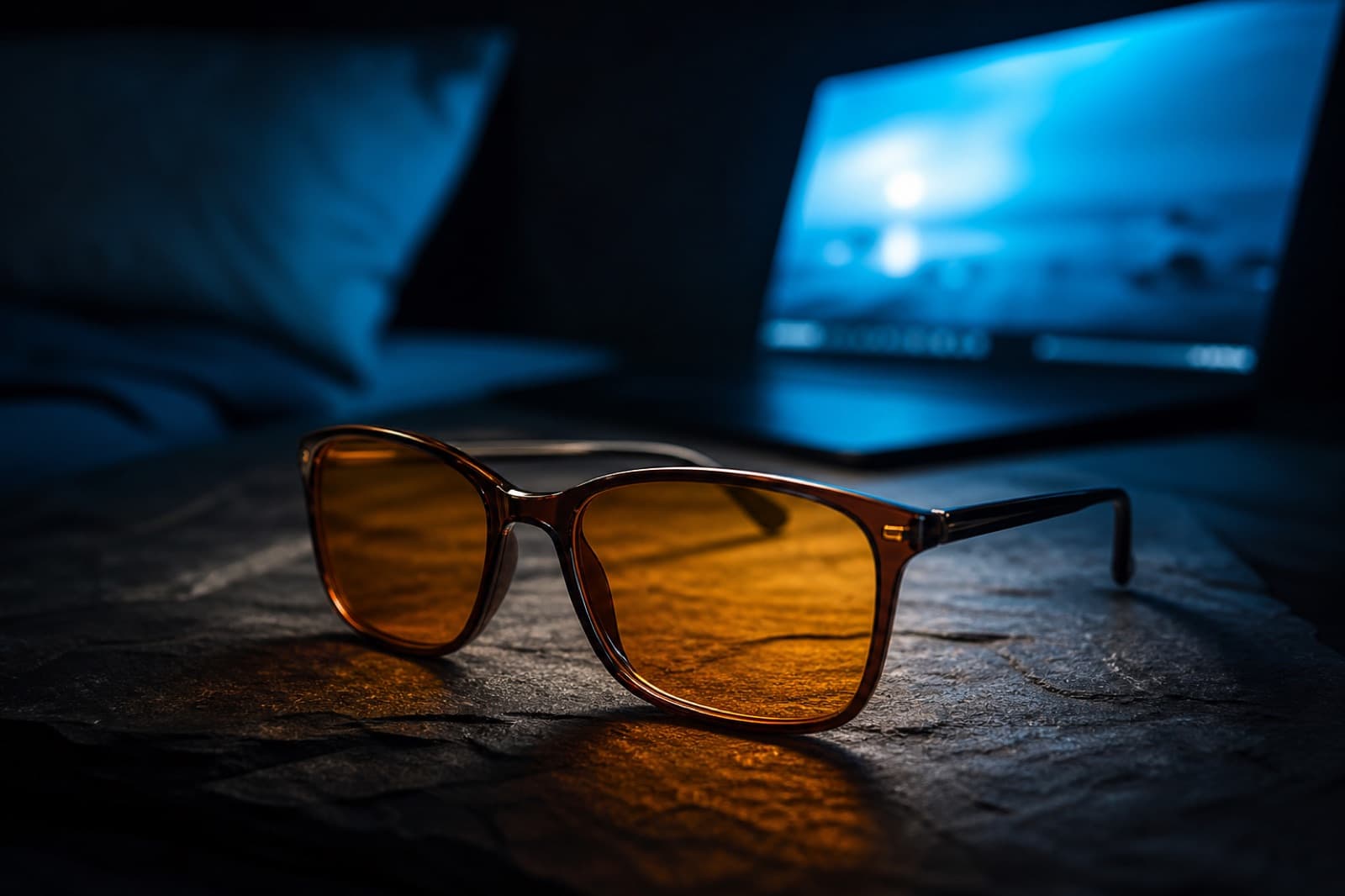
If you train, work, or scroll late — which most of us do — proper evening blue-blockers are the practical backstop. The key word is amber/orange-tinted, worn in the 1–2 hours before bed. Clear "blue-light filter" lenses block far less of the relevant wavelengths.
These are my evening pair — screens, overhead lights, wind-down. Not stylish at a restaurant; effective at home on hard training weeks. Put them on when you can't avoid late screens and want to protect the sleep that's doing your recovery.
5. Clean up the rest of the sleep environment
Light is one input. Cool, dark, quiet room; consistent sleep/wake times; and a calm space all stack. For a deeper room-environment layer:
Buy the glasses before the harmonizer if budget is tight — circadian light hygiene is the higher-ROI move.
A Simple Evening Light Protocol
- Sunset: Dim overhead lights, switch to warm lamps, devices to night mode.
- 2 hours before bed: Amber blue-blockers on if you're still on screens.
- 30–60 min before bed: Screens off if you can. Read (print or e-ink), stretch, wind down.
- Bedroom: Dark, cool, quiet. Same bedtime nightly.
- Morning: Bright light within an hour of waking — this is half the equation.
How This Fits Dark Kinetics
Light hygiene is the "environment" layer of the full recovery stack — it sits underneath sleep itself. It won't out-train bad programming or poor nutrition, but it's one of the cheapest ways to protect the sleep that turns training into adaptation.
Bottom Line
Evening blue light delays your body clock and suppresses melatonin — and that costs you recovery. Morning bright light plus a darker, screen-light evening is the foundation. Amber blue-blocking glasses worn in the 1–2 hours before bed are a well-supported backstop for unavoidable late screens. All-day "computer glasses" for eye strain? Skip the hype and save it for the evening, where the science actually holds up.
Next: cold as a deliberate autonomic apparatus, and what twelve weeks of it costs — the ice arithmetic.
References
- [1]Chang AM, Aeschbach D, Duffy JF, Czeisler CA. “Evening use of light-emitting eReaders negatively affects sleep, circadian timing, and next-morning alertness.” Proceedings of the National Academy of Sciences, 2015
- [2]Shechter A, Kim EW, St-Onge MP, Westwood AJ. “Blocking nocturnal blue light for insomnia: A randomized controlled trial.” Journal of Psychiatric Research, 2018
- [3]Burkhart K, Phelps JR. “Amber lenses to block blue light and improve sleep: a randomized trial.” Chronobiology International, 2009
- [4]Ostrin LA, Abbott KS, Queener HM. “Attenuation of short wavelengths alters sleep and the ipRGC pupil response.” Ophthalmic & Physiological Optics, 2017
Dark Kinetics
The five scrolls Musashi sealed at Reigandō in 1645, restored as a training doctrine and welded to cellular measurement.
Denshō
Earth, Water, Fire, Wind, Void — the doctrine this record sits inside. No consultation, no call to schedule.
OPEN THE DENSHŌ